
LDS Laser Direct Structuring Platable Plastics · LDS Mobile Phone Antennas · LDS Smartwatch Materials
LDS (laser direct structuring) platable plastics for 3D circuits in mobile phone antennas, smartwatches and more.
Request a Sample Ask an Engineer →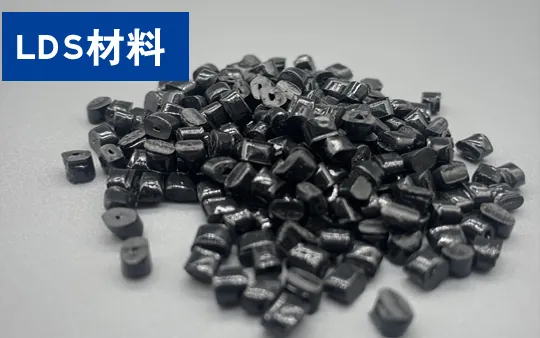
- No photomask required.
- Very high mechanical strength
- Stable dimensional accuracy
- Excellent chemical resistance
- High-temperature resistant, suitable for high-temperature molding
- Good flow, easy to mold
Introduction to LDS Plastics
- LDS plastics enable a 3D-MID (three-dimensional molded interconnect device) production technology based on specialized laser processing, injection molding and plating. It integrates into a single part the electrical interconnection and component-support functions, the support and protection functions of a plastic housing, and the shielding, antenna and other functions created by combining the mechanical body with conductive patterns, forming what is known as a 3D-MID.
- Put simply, LDS uses laser technology to directly "print" a three-dimensional circuit onto a new type of plastic part. Conventional circuit boards are no longer needed and circuit design becomes more flexible. Assembly is also easier, and most importantly, product size can be reduced significantly.
Features of LDS Plastics
- Easy to modify during development, with low prototyping costs.
- Plating of plastic components does not affect antenna characteristics or stability.
- Higher output and smaller products, in line with the trend toward thinner smart devices.
- Short design and development time, with customized designs to customer requirements.
- Suitable for laser drilling.
- Compatible with SMT processes.
- No photomask required.
LDS Plastic Processing Steps
- Injection molding of LDS material: plastic pellets are formed using an injection molding machine and mold
- Laser activation of LDS molded parts: an energy beam ablates selected areas of the plastic, removing the surface etch-resist layer and exposing the metal complexes embedded in the plastic, improving chemical plating in the selected areas.
- Metallization of LDS circuit patterns: through plating, copper, nickel, gold and other metals adhere to the laser-activated areas, turning the plastic part into an MID component with conductive traces.
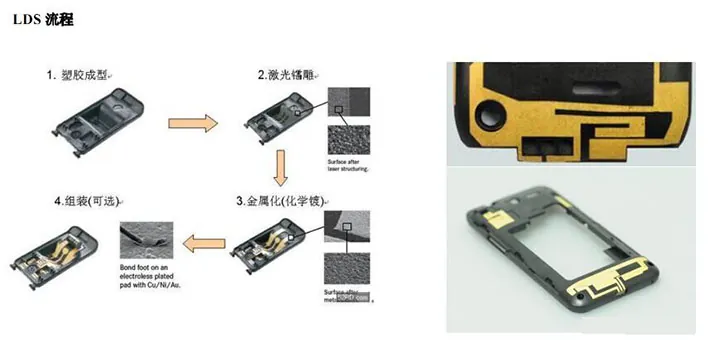
LDS plastic processing flow chart
Current LDS Plastic Grades
| Grade | Model | Properties |
|---|---|---|
| PC | XR7015-LM | Excellent chemical resistance and high-temperature stability, with outstanding mechanical properties. |
| PC | XR7015-LMT | Excellent chemical resistance and high-temperature stability, with outstanding mechanical properties. |
| PC | XR7015-LMG2/4/6 | 10–30% special glass fiber reinforced, excellent surface finish and dimensional accuracy, with outstanding mechanical properties. |
| PC/ABS | XRHF420-LM | PC/ABS alloy, outstanding mechanical properties, easy to mold. |
| PBT | XRBT200-LM | PBT, glass fiber reinforced, excellent surface finish and dimensional accuracy, with outstanding mechanical properties. |
| PPA | XRHT-LM | PPA, glass fiber reinforced, excellent surface finish and dimensional accuracy, high-temperature resistant, SMT process compatible. |
| PPA | XRHT-LM/BK-DC | PPA, glass fiber reinforced, high dielectric constant (>6.0) with low dielectric loss, excellent surface finish and dimensional accuracy, high-temperature resistant, SMT process compatible. |
LDS Plastic Application Examples
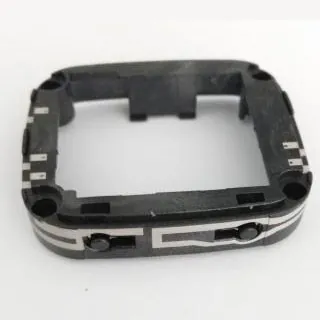
LDS plastic in smartwatch applications

LDS plastic resins in electronics applications
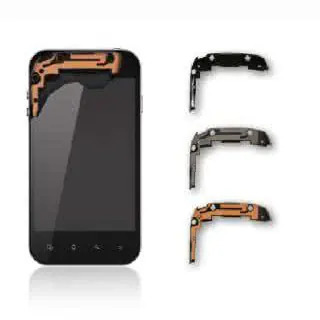
LDS plastic in mobile phone antenna applications
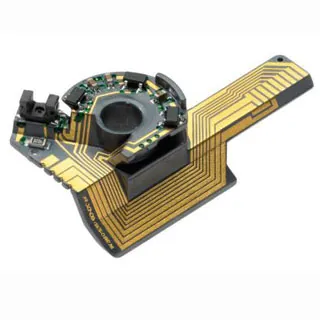
LDS plastic in camera applications