Excellent wear resistance, low noise, reduced stick-slip, elimination of external lubricants and improved abrasive wear performance
Excellent wear resistance, low noise, reduced stick-slip, no external lubrication needed, and improved abrasive wear performance.
Request a Sample Ask an Engineer →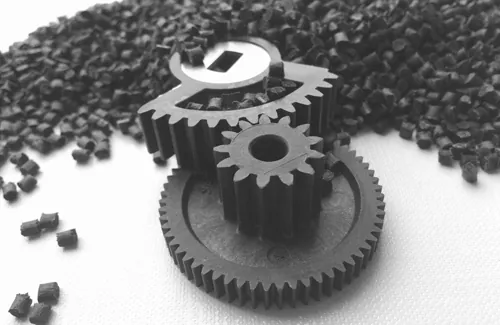
Our tribology experts provide wear- and friction-resistant solutions for mating and moving parts. We have gathered extensive data on our broad portfolio of materials designed to solve many wear- and friction-related problems, so your plastic applications run smoothly and quietly!
We can add the following lubricants, additives and fillers (among others):
- PTFE powder
- Carbon fiber
- Silicone
- Graphite
Typical Features of Wear-Resistant Plastics
- Typical properties include: excellent wear resistance, low noise, reduced stick-slip, elimination of external lubricants and improved abrasive wear performance.
- Other key features include: low thermal expansion, good fatigue endurance, high creep resistance and load-bearing capacity, and excellent impact strength and dimensional stability.
- Commonly used in automotive, electrical and durable consumer goods applications, including door lock mechanisms and seat adjustment assemblies in vehicles, and gears, bushings and bearings in durable consumer goods and electronics.
- Wear-resistant additives such as PTFE powder, silicone, MoS2, graphite and aramid are used as internal lubricants in a variety of engineering resins (PA, PBT, PC, POM, etc.).
- Reinforced lubricated grades are available. When better mechanical or thermal performance is needed, glass or carbon fiber reinforcement can be used: low thermal expansion, good fatigue endurance, high creep resistance and load-bearing capacity, improved temperature performance, and excellent impact strength and dimensional stability.
Plastic Wear Testing: Methods & Equipment
Plastic wear tester
- Self-lubrication testing performed per JIS K7218.
-
- Load = 50 N
- Speed = 50 cm/s
- Test duration = 100 min
- Test Items
-
- Wear loss: weight lost by the specimen after rubbing against a steel disc
- Dynamic coefficient of friction: the load generated by the specimen rubbing against a steel disc
Wear-Resistant POM vs. Standard POM Properties
| Test Item | Test Method | Unit | Standard Material | Modified Wear-Resistant Material | |||
|---|---|---|---|---|---|---|---|
| POM | Wear-resistant grade A | Wear-resistant grade B | |||||
| Density ISO1138 kg/m3 | 1,225 | - | 1.41 | 1.41 | 1.41 | ||
| Sliding properties | Wear loss | JIS K 7218 | mg | 95.3 | 1.5 | 3.6 | |
| Dynamic coefficient of friction | - | 0.38 | 0.13 | 0.26 | |||
| Mechanical properties | Tensile | Strength |
ISO 527-1 |
MPa | 61 | 60 | 46 |
| Elongation | % | 30 | 35 | 55 | |||
| Flexural | Strength |
ISO 178 (JIS K 7171) |
MPa | 87 | 80 | 60 | |
| Modulus | MPa | 2500 | 2300 | 1700 | |||
| Izod impact strength (notched) |
ISO 180 (JIS K 7110) |
KJ/M2 | 6 | 8 | 12 | ||
| Mold shrinkage | Xresin in-house test method | % | ISO 294-4 | % | 2.0 | 2.0 | 1.7–1.9 |