
Thermally conductive compounds can transfer heat effectively even through plastic components, offering multiple weight and chemical-resistance advantages over metals such as aluminum.
Thermally conductive compounds transfer heat effectively through plastic parts, offering weight and chemical-resistance advantages over metals such as aluminum.
Request a Sample Ask an Engineer →
Features of Thermally Conductive Plastics
- Uniform heat dissipation, avoiding hot spots and reducing localized part deformation caused by high temperatures
- Lightweight: 40–50% lighter than aluminum
- Easy to mold, no secondary processing required
- High design freedom
- Main base resins: PPS, PA6/PA66, LCP, TPE, PC, PP, PPA, PEEK, etc.
- Main fillers: AlN, SiC, Al2O3, Mg(OH)2, graphite, etc.
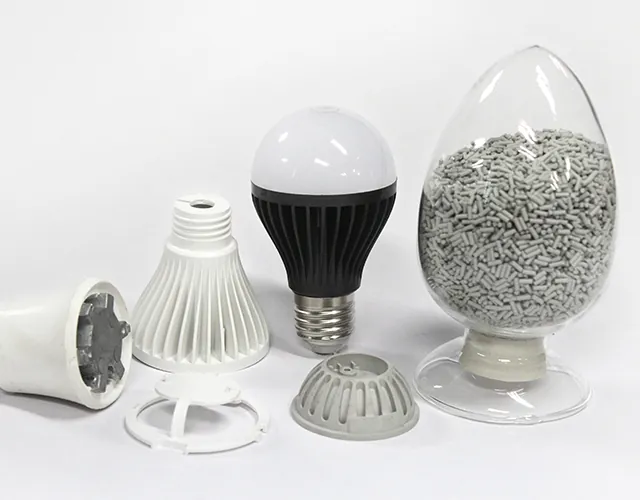
Thermally Conductive Plastics
Classification: by the route used to improve thermal conductivity, thermally conductive plastics can be divided into:
- Intrinsically conductive plastics: polymers synthesized with high thermal conductivity, such as polymers with complete crystallinity that conduct heat via phonons
- Filled thermally conductive plastics: polymers filled with highly conductive particles, fibers, platelets, etc.
Filled thermally conductive plastics fall into two categories:
- Thermally conductive, electrically insulating plastics: main fillers include metal oxides (Al2O3, MgO, SiO2), metal nitrides (AlN, Si3N4, BN), SiC, B4C3, etc.
- Thermally and electrically conductive plastics: thermal conductivity of 5.0 W/m·K or higher; main fillers include metal powders/fibers, graphite, carbon fiber, CNT, graphene, etc.